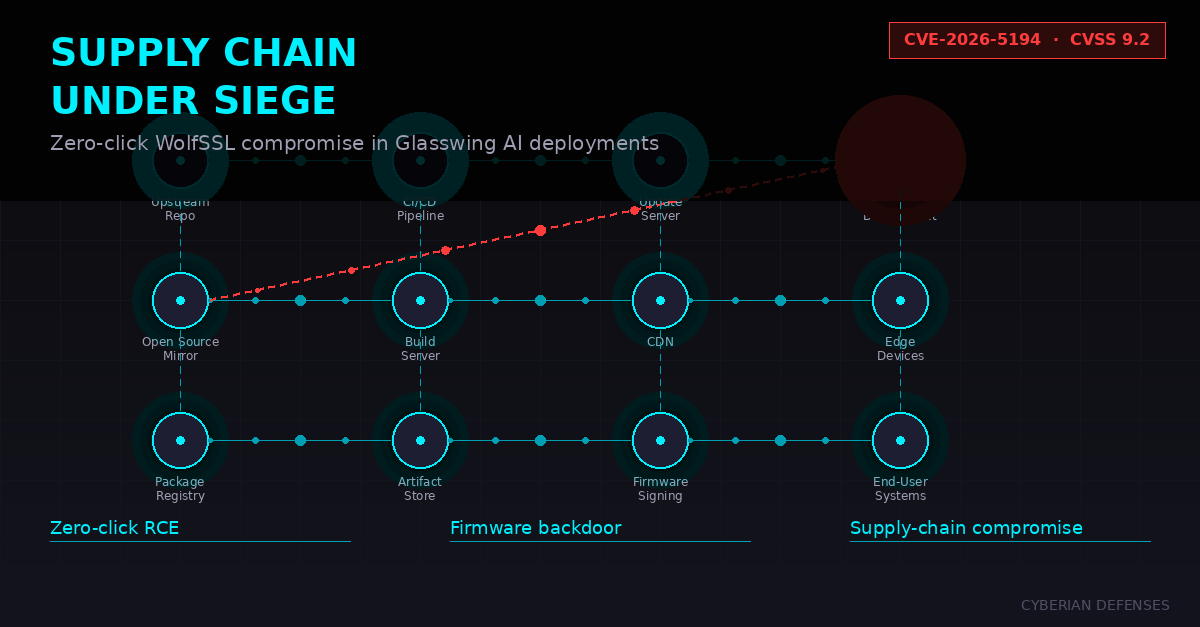
The Vulnerability
CVE-2026-5194 is a critical heap-based buffer overflow in WolfSSL versions 5.7.0 through 5.7.2. The vulnerability exists in the TLS handshake processing path when handling malformed certificate chain extensions. An attacker can trigger the overflow by serving a crafted certificate during the TLS handshake — no user interaction required.
The flaw was discovered in the context of Glasswing AI deployments, which embed WolfSSL for secure communications between edge devices and their cloud inference infrastructure. Because Glasswing uses automatic firmware updates that include WolfSSL updates, this becomes a supply chain attack vector: compromise the library, and you compromise every device pulling updates.
Attack Chain
The attack proceeds in three stages:
- Library Compromise (Stage 1): Attacker exploits CVE-2026-5194 against WolfSSL’s build infrastructure or an update mirror. The buffer overflow allows arbitrary code execution in the context of the TLS handshake — which runs with elevated privileges in most deployments.
- Supply Chain Poisoning (Stage 2): The compromised WolfSSL binary is signed with the legitimate build key and distributed through normal update channels. Glasswing AI devices fetch the update automatically and deploy it. The malicious code sits dormant to avoid detection.
- Payload Activation (Stage 3): After a configurable delay, the malicious WolfSSL opens a reverse shell to an attacker-controlled C2 server. From there, the attacker has full access to the edge device — including model weights, inference data, and lateral movement capability into the cloud infrastructure.
Impact Assessment
The blast radius is significant:
- All Glasswing AI deployments running WolfSSL 5.7.0–5.7.2 are vulnerable
- Edge devices processing sensitive data (healthcare, finance, defense) are at highest risk
- Compromised devices can leak model weights, training data, and inference results
- Lateral movement from edge to cloud infrastructure is possible through API keys stored on the device
Detection and Mitigation
Immediate actions:
- Upgrade WolfSSL to 5.7.3+ (patch released May 24, 2026)
- Verify TLS certificate chain validation settings — disable fallback to weakened validation
- Monitor edge device network traffic for unexpected outbound connections (especially to non-standard ports)
- Audit firmware update signatures — confirm no updates were signed during the vulnerable window without corresponding source changes
- Deploy network segmentation between edge devices and cloud infrastructure
For immediate detection, use the following Snort rule to catch exploitation attempts:
alert tcp any any -> any 443 (msg:"CVE-2026-5194 WolfSSL Heap Overflow Attempt"; flow:to_server,established; content:"|16 03|"; depth:2; content:"|0b|"; distance:3; within:1; byte_test:2,>,500,0,relative; sid:20265194; rev:1;)
Published simultaneously on LinkedIn
Follow Ahmed Chiboub for daily cybersecurity insights.